2INGIS® Legs (Long & Short)
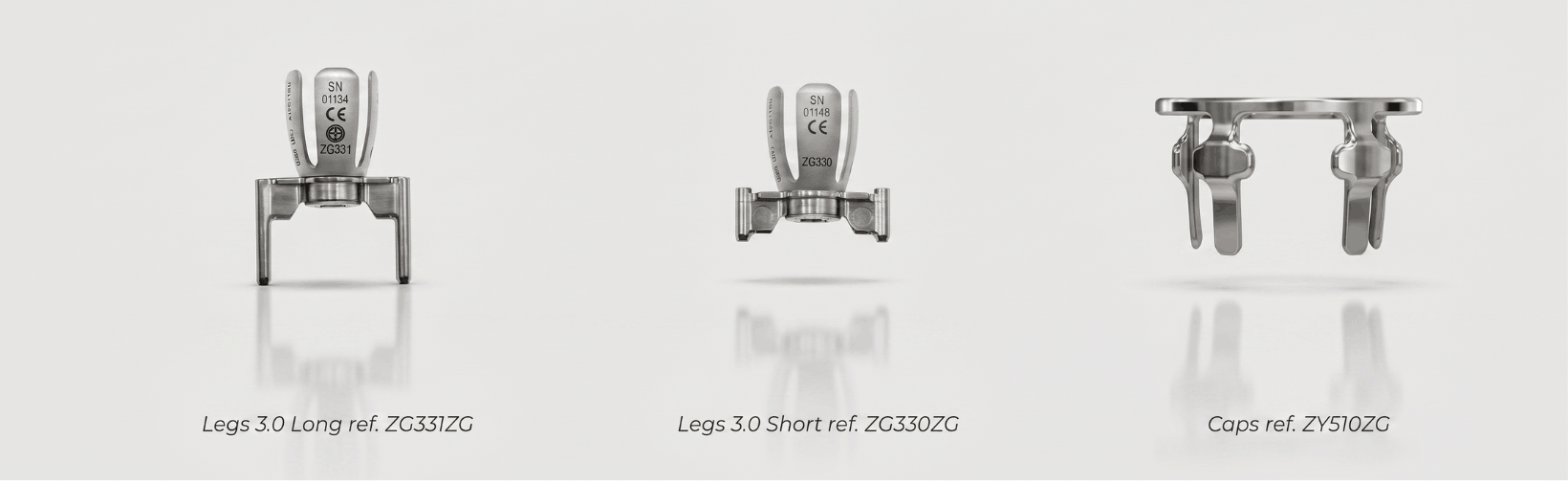
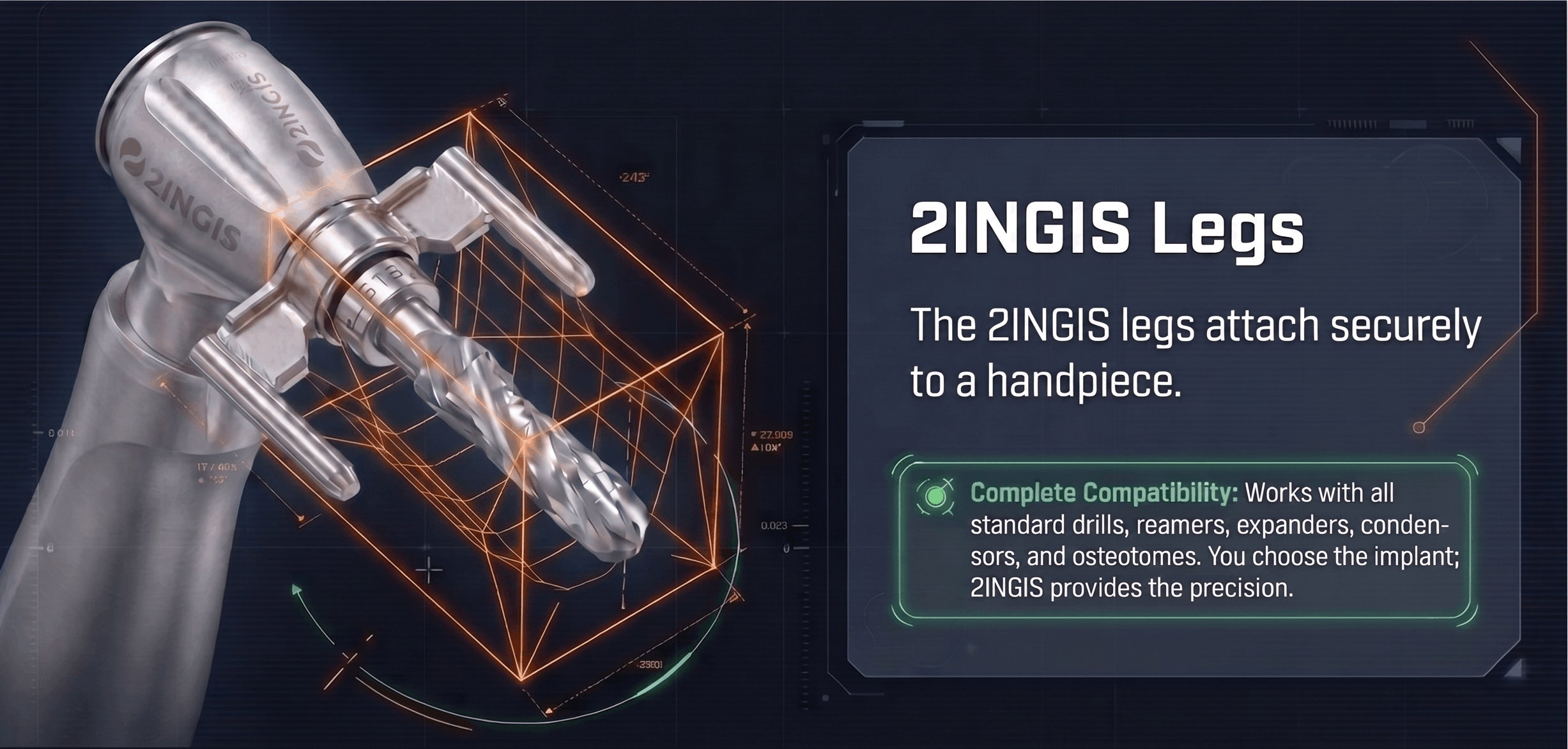
Legs are steel, reusable medical devices that attach to the head of a W&H or NSK surgical handpiece. The legs are offered as a set both long & short.
Purpose: The guide legs serve act as an external support. These guide legs fit into a custom surgical guide, precisely directing the handpiece and the drill during surgery offering accuracy within 0.15mm
The Long Legs: The standard is used for initial stages of drilling. They provide optimal guidance and stabilisation for the handpiece, establishing the correct angulation and trajectory before the anatomy or tissue require s switch to the shorter legs.
The Short Legs: This is used specifically when the final drilling depth cannot be reached because the Long Legs touches the gingiva, bone, or teeth prematurely. In these instances, you switch from long legs to short legs to complete the procedure.
Safety: The legs must be inserted into the surgical guide before the drill bit makes contact with the patient's bone
Caps: Serve as a secure attachment to the hand-piece
Maintenance: The Legs must undergo a full 4-step reprocessing cycle (Cleaning, Disinfection, Inspection, and Sterilization)
Download sample 2INGIS STL file
(download on PC (not phone))
2INGIS® Spacers
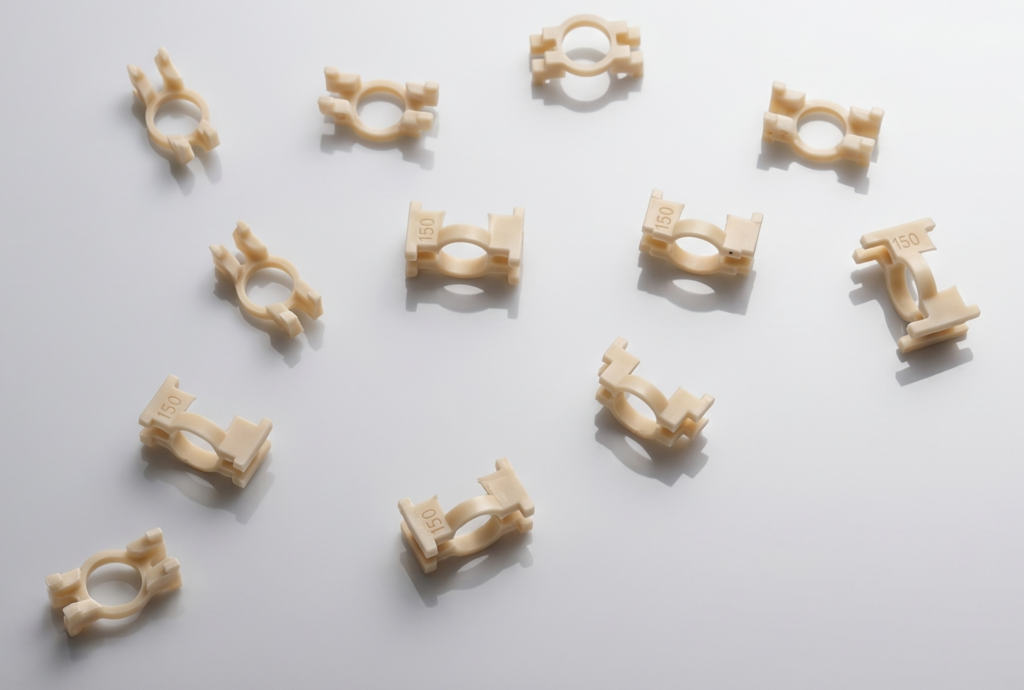
Spacers are resin components that attach directly to the 2ingis® Legs to control drilling depth
Adjustable Depth: They allow for precise adjustment of the borehole length according to the specific surgery required.
Variety: They are available in 19 different sizes, ranging from 1.0 mm to 10.0 mm in height.
Identification: Each spacer is marked with a number that corresponds to its specific height/size.
Single Use: Unlike the legs, spacers are non-reusable and must be disposed of after a single use. The spacers are printed as required for each patient and applied specifically for each implant position to control depth
Maintenance: The Legs must undergo a full 4-step reprocessing cycle (Cleaning, Disinfection, Inspection, and Sterilization)
Download sample 2INGIS Spacer STL file
(download on PC (not phone))
2INGIS® Surgical Guided Solution
The 2ingis® Legs (Long and Short) are essential components of the sugical guided solution. Unlike traditional surgical guides that use "sleeves" (tubes) to guide the drill, the 2ingis system uses an "external" guidance method.
Here is why you need both the Long and Short versions:
1. Depth and Space Control
The "Legs" act as the interface between your surgical handpiece (the drill) and the patient’s custom 3D-printed surgical guide.
- Long Legs: Used when there is more vertical room or when the implant needs to be placed at a specific depth relative to the guide height.
- Short Legs: Designed for restricted spaces, such as the back of the mouth (posterior region) where the patient cannot open their mouth wide. Using shorter legs can save up to 25mm of vertical space, making guided surgery possible in "small mouth" cases.
2. Precise Drill GuidanceThe legs clip onto the head of the handpiece. During surgery, the two "rods" of the legs slide into corresponding slots on the surgical guide. This ensures:
- Perfect Angulation: The drill cannot tilt; it stays exactly on the planned axis.
- Free Rotation: Because the guidance happens outside the mouth via the legs, the drill bit itself doesn't touch the guide. This allows for optimal cooling (water reaches the bone easily) and prevents plastic/metal debris from falling into the surgical site.
3. Customization with Spacers
You may have noticed the small Spacers in your second image. These are designed to be "plugged" onto the legs:
- By combining a specific leg (Long or Short) with a specific Spacer (ranging from 1.0mm to 8.0mm), you can calibrate the exact drilling depth.
- This allows you to use standard-length drills while still achieving the high precision needed for different implant lengths.
In short, you need both to ensure you can treat every patient—whether they have a wide-open bite or a very limited opening—while maintaining 100% accuracy in where the implant is placed.
Download sample 2INGIS STL file
(download on PC (not phone))